Developments of Interest


View Developments of Note in a larger map

Sunday, January 17, 2010

Self Control is Contagious / ...or the lack Thereof!

This would sure explain a lot of the mechanism by which 12-Step programs work.
..and perhaps the reasons we need them in the first place!
;-)


University of Georgia: Public Affairs
Self-control is contagious, study finds
Writer: Sam Fahmy, 706/542-5361, sfahmy@uga.edu
Contact: Michelle vanDellen, 706/542-2174, mvd@uga.edu
Jan 13, 2010, 16:11


Athens, Ga. – Before patting yourself on the back for resisting that cookie or kicking yourself for giving in to temptation, look around. A new University of Georgia study has revealed that self-control—or the lack thereof—is contagious.

In a just-published series of studies involving hundreds of volunteers, researchers have found that watching or even thinking about someone with good self-control makes others more likely exert self-control. The researchers found that the opposite holds, too, so that people with bad self-control influence others negatively. The effect is so powerful, in fact, that seeing the name of someone with good or bad self-control flashing on a screen for just 10 milliseconds changed the behavior of volunteers.

“The take home message of this study is that picking social influences that are positive can improve your self-control,” said lead author Michelle vanDellen, a visiting assistant professor in the UGA department of psychology. “And by exhibiting self-control, you’re helping others around you do the same.”

People tend to mimic the behavior of those around them, and characteristics such as smoking, drug use and obesity tend to spread through social networks. But vanDellen’s study is thought to be the first to show that self-control is contagious across behaviors. That means that thinking about someone who exercises self-control by regularly exercising, for example, can make your more likely to stick with your financial goals, career goals or anything else that takes self-control on your part.

VanDellen’s findings, which are published in the early online edition of the journal Personality and Social Psychology Bulletin, are the result of five separate studies conducted over two years with study co-author Rick Hoyle at Duke University.

In the first study, the researchers randomly assigned 36 volunteers to think about a friend with either good or bad self-control. Those that thought about a friend with good self-control persisted longer on a handgrip task commonly used to measure self-control, while the opposite held true for those who were asked to think about a friend with bad self-control.

In the second study, 71 volunteers watched others exert self-control by choosing a carrot from a plate in front of them instead of a cookie from a nearby plate, while others watched people eat the cookies instead of the carrots. The volunteers had no interaction with the tasters other than watching them, yet their performance was altered on a later test of self-control depending on who they were randomly assigned to watch.

In the third study, 42 volunteers were randomly assigned to list friends with both good and bad self-control. As they were completing a computerized test designed to measure self-control, the computer screen would flash the names for 10 milliseconds—too fast to be read but enough to subliminally bring the names to mind. Those who were primed with the name of a friend with good self-control did better, while those primed with friends with bad self-control did worse.

In a fourth study, vanDellen randomly assigned 112 volunteers to write about a friend with good self-control, bad self-control or—for a control group—a friend who is moderately extroverted. On a later test of self-control, those who wrote about friends with good self-control did the best, while those who wrote about friends with bad self-control did the worst. The control group, those who wrote about a moderately extroverted friend, scored between the other two groups.

In the fifth study of 117 volunteers, the researchers found that those who were randomly assigned to write about friends with good self-control were faster than the other groups at identifying words related to self-control, such as achieve, discipline and effort. VanDellen said this finding suggests that self-control is contagious because being exposed to people with either good or bad self-control influences how accessible thoughts about self-control are.


VanDellen said the magnitude of the influence might be significant enough to be the difference between eating an extra cookie at a party or not, or deciding to go to the gym despite a long day at work. The effect isn’t so strong that it absolves people of accountability for their actions, she explained, but it is a nudge toward or away from temptation.

“This isn’t an excuse for blaming other people for our failures,” vanDellen said. “Yes, I’m getting nudged, but it’s not like my friend is taking the cookie and feeding it to me; the decision is ultimately mine.”

The research was supported by the National Institute on Drug Abuse.
##


http://www.uga.edu/news/artman/publish/printer_100113_SelfControlStudy.shtml

Saturday, January 16, 2010

I just created a Facebook page for "Dingbats"

The "Dingbats" are those usually ugly eyesore stucco box apartment buildings that are all over the West Coast and the Sunbelt.


They represent to me the worst in tasteless design, bad architecture, poor urban planning and pedestrian-unfriendliness. Some of them, however, take 'bad' to a whole new level of kitschy high art.

Check them out on the FB page.... Dingbat "Fan" page.

Wiki on Dingbats:
"A dingbat is a type of formulaic apartment building that flourished in the Sun Belt region of the United States in the 1950s and 1960s, a vernacular variation of shoebox style "stucco boxes". Dingbats are boxy, two- or three-story apartment houses with overhangs sheltering street-front parking.[1] The elevation view of a dingbat is "half parking structure, half dumb box."[2]
Popular in Southern California, but also found in Arizona, Florida, Hawaii, Nevada and Vancouver, dingbats are known for their downmarket status and inexpensive rents. Some replaced more distinctive but less profitable building structures, such as single-family Victorian homes.[3] Since the 1980s they have been the subject of aesthetic interest as examples of Mid-Century modern design and kitsch, since many dingbats have themed names and specialized trim. Dingbats are also reviled as socially alienating visual blights; California historian Leonard Pitt said of them, "The dingbat typifies Los Angeles apartment building architecture at its worst."[1]"

Wiki Dingbat entry

Tuesday, December 29, 2009

New Identity? Title? Themes?

I only recently started this blog, and a few others so I could share about the many different things I come across and find interesting. Much of what I stumble across are lesser-known ideas or real projects that could use more public support.

I started three blogs - but very quickly realized I needed to focus my efforts on only one, but that that ONE had to have content about ALL of my different interests. Which, over time, I'm sure you'll see, extend far beyond just the urban design and transportation issues I've been linking to on here so far.

There are some common themes though that I hope will emerge. Some of them I considered as names for the blog. "Genius Loci" was of them. It's a recurring theme in my thoughts that I'm sure will become apparent over time with my posts.

The "Genius Loci" translates to mean "Spirit of the Place." It's an ancient concept that goes back beyond the Romans from whom we get the term. The term featured prominently in my Architecture, Design and Landscape studies at my university. Each of my instructors (or "critics" as they're called in Architecture) was heavily influenced by the work and writings of Aldo Rossi, Robert Venturi and Lou Kahn. Each of these greats often spoke or wrote about finding something about the innate nature of the places or forms with which they worked. Those ideas really stuck with me, and 20+ years later - I still recall the words of and assignments by my instructors, and with each of my own new life experiences there is new light shed upon what I remember learning way back then.

What seemed like a quaint or cute concept back then is blossoming into something very real, very spiritual, awesome and more tangible with every day I combine my own experience, strength and hope with what the Genius Loci of each place has to reveal or inspire for me. The lessons of the Genius Loci can be easily lost in noise, ego or fear. It requires an inner peace, a quietude and patience to get to know a place and hear what the Spirit of the Place has to say.

I've lived in West Hollywood and Los Angeles for almost two years now. It's only very recently that I've been able to hear what this Genius Loci has to say. Why and how I came here, and why only now do I have the quietude, the presence and the stillness to listen will be the topics for future writings here. ...but for right now though, I'm content to feel and deeply understand why The Spirit of this place calls it the "The City of Angels."

Curbed LA: CurbedWire: Hollywood Park Looks So Very Nice and Green

LAFreewayPark.png

Curbed LA: CurbedWire: Hollywood Park Looks So Very Nice and Green: ""


(Via Curbed LA.)


This is a brilliant Idea!

Wednesday, December 2, 2009

Uh-Oh! I hope this essential project doesn't get sidetracked by NIMBYism


L.A. City Council wants bullet train officials to weigh two options for Union Station
December 2, 2009 | 2:39 pm
The Los Angeles City Council unanimously urged officials at the California High Speed Rail Authority today to consider two proposed alternatives for the bullet train stop at Union Station downtown.

Councilman Ed Reyes said the alternatives were crucial to protecting the residents in East Los Angeles as planners determine the route for the 800-mile bullet train between Northern California and San Diego. Proponents say the train would carry passengers from Los Angeles to San Francisco in about 2½ hours.

The two alternatives are:
An aerial stop at Union Station where the bullet train would be stacked above Metrolink tracks, or
A stop on the east side of Patsaouras Transit Plaza, along Vignes Street.
A city planner said the second option could minimize intrusions into communities north and south.

Voters approved a $10-billion bond measure for the bullet train in 2008 and the state is seeking additional federal money in the hope of beginning construction on a first phase between Anaheim and L.A. as early as 2011. Reyes is concerned that the likely route north from Union Station along the Los Angeles River would destroy the city’s plans to rehabilitate the river as well as disrupt the lives of residents in communities including Lincoln Heights, Cypress Park and Elysian Valley.

Reyes cited Chicago’s Millennium Park, which was built above railroad tracks and parking, as an example of the opportunities that lie ahead for Los Angeles as the project advances.

“We should be opening our eyes to what could be,” Reyes said. “…In your hands lies a unique opportunity to create a facility that should last the next 100 years. But let’s do it with the understanding that we can create relief and improvements.”

He said the project “can create a grand Union Station for the state of California without having the communities [have] to bear the burdens on their backs.”

Reyes demanded a public commitment that rail authority officials would consider both options, which he said could determine the path of the train as it heads north from the station.

Valerie Martinez, Southern California communications director for the High Speed Rail Authority, assured Reyes that the draft environmental impact report would include a second alternative. “There will be two options that your community will be able to look at and determine how each of those impacts the communities,” she said.

-- Maeve Reston at L.A. City Hall

Friday, November 13, 2009

Thursday, November 12, 2009

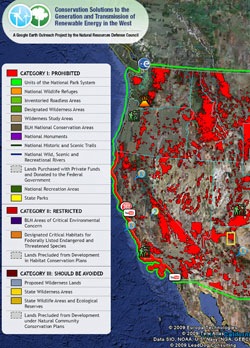
NRDC: Clean Energy and Conservation: Mapping Tool to Identify Low-Impact Sites for Renewable Energy Development.

60D33F0E-EFA8-462A-864D-451D5D75A279.jpg
NRDC: Clean Energy and Conservation: ""


(Via .)


Lovers of the American West will tell you that it's blessed -- and they're right. It's home to significant sources of renewable energy, such as solar, wind and geothermal power. The Western states, their residents and the nation will need these resources to repower America and meet the challenge of global warming.

But the West is also home to remarkable wildlands, diverse wildlife and irreplaceable cultural resources. That makes it vital to find the best sites for new clean energy projects and transmission lines, so that America can harness renewable power while doing the least damage to the Western environment.

Working with Google Earth, NRDC has developed this interactive resource to help environmentalists, renewable energy developers, utility companies and others meet these challenges.