Wednesday, May 30, 2012


Thursday, May 17, 2012
"The Idealogical Turing Test"
Greg recently sent me a link to a great post on Patheos, called the "Idealogical Turing Test."
I was intrigued, so I entered. One of the questions is:
"Write a brief (~50 word) bio of yourself and your religious affiliation. These get published at the end and help me build up a range of interesting participants"
Well ...I started writing and.... a few more than 50 words spilled out, so I thought I'd share them here!
"I was raised Roman Catholic and attended 12 years of Catholic School. Grades 1-8 at a small diocesan elementary school where I was always getting into trouble with the nuns. High School was at a private, independent Catholic prep school run by an order of very progressive and (then) left-leaning brothers. I attended college at the Quaker-heritage University of Pennsylvania, where I came out as a gay man.
I spent many years angry with and estranged from the Catholic Church and considered myself agnostic. I was raised to think most other faiths were "shams" or pale imitations. Eventually I began reading more about Wicca, Quaker, Buddhism, Mormon and other faiths and began to become more open.
In my 30's, feeling a spiritual void, I began to explore Unitarian, Congregationalist, MCC and progressive Episcopal churches. I found some touch points with each - but none felt like "home."
Almost at 40, I moved from the city to a rural, small ranch in the high desert near Joshua Tree with my partner. The beauty and rhythm of the natural world were ever-present. I began to explore earth-based ritual, religions and Wicca. They seemed "natural" and right there.
After a series of personal tragedies, addiction, etc in my life I became angry with God, the Universe etc and moved to L.A. At MCC L.A. at a low point near my "bottom" I was re-baptized and became open to The Spirit again. My life changed.
I eventually found a safe, comfortable home with St Thomas the Apostle, Episcopal Church in Hollywood. It's very old-school, high church, but feels familiar and comfortable.
At this point in my life my theology is a hybrid of good bits from all I've sampled. However I feel they are all poor metaphors attempting to describe the ultimate indescribable mysteries of incarnation, the nature of God and the Spirit of the Universe. I find the traditional Christian metaphors I was raised with to be most comfortable - but I still consider them useful metaphors. My actual theology today more resembles Quakerism + Sagan's Contact + Battlestar Galactica than St. Paul, but I am now comfortable with celebrating old-fashioned ritual amidst personal ambiguity."
I was intrigued, so I entered. One of the questions is:
"Write a brief (~50 word) bio of yourself and your religious affiliation. These get published at the end and help me build up a range of interesting participants"
Well ...I started writing and.... a few more than 50 words spilled out, so I thought I'd share them here!
"I was raised Roman Catholic and attended 12 years of Catholic School. Grades 1-8 at a small diocesan elementary school where I was always getting into trouble with the nuns. High School was at a private, independent Catholic prep school run by an order of very progressive and (then) left-leaning brothers. I attended college at the Quaker-heritage University of Pennsylvania, where I came out as a gay man.
I spent many years angry with and estranged from the Catholic Church and considered myself agnostic. I was raised to think most other faiths were "shams" or pale imitations. Eventually I began reading more about Wicca, Quaker, Buddhism, Mormon and other faiths and began to become more open.
In my 30's, feeling a spiritual void, I began to explore Unitarian, Congregationalist, MCC and progressive Episcopal churches. I found some touch points with each - but none felt like "home."
Almost at 40, I moved from the city to a rural, small ranch in the high desert near Joshua Tree with my partner. The beauty and rhythm of the natural world were ever-present. I began to explore earth-based ritual, religions and Wicca. They seemed "natural" and right there.
After a series of personal tragedies, addiction, etc in my life I became angry with God, the Universe etc and moved to L.A. At MCC L.A. at a low point near my "bottom" I was re-baptized and became open to The Spirit again. My life changed.
I eventually found a safe, comfortable home with St Thomas the Apostle, Episcopal Church in Hollywood. It's very old-school, high church, but feels familiar and comfortable.
At this point in my life my theology is a hybrid of good bits from all I've sampled. However I feel they are all poor metaphors attempting to describe the ultimate indescribable mysteries of incarnation, the nature of God and the Spirit of the Universe. I find the traditional Christian metaphors I was raised with to be most comfortable - but I still consider them useful metaphors. My actual theology today more resembles Quakerism + Sagan's Contact + Battlestar Galactica than St. Paul, but I am now comfortable with celebrating old-fashioned ritual amidst personal ambiguity."
Friday, May 11, 2012

Tuesday, May 10, 2011

Tuesday, April 27, 2010
A Subway Through Bellevue, WA?!
I'm very surprised they're seriously considering a tunnel through Bellevue. It looks to me like there is already a terriffic off-street right od way available, and there does not seem to be the density there to support the cost of a tunnel.
Bellevue%20council%27s%20offer%20keeps%20light%2Drail%20tunnel%20alive
Bellevue%20council%27s%20offer%20keeps%20light%2Drail%20tunnel%20alive
What Los Angeles Metro could look like in 10 years if May Villaraigosa's 30/10 Plan Moves Foreward.

Funding is already in-place for all of these projects, but the money flows-in from Measure R funds over the next 30 years. The Mayor's idea is to ask Washington to fund a loan against the future Measure R income, to allow all of this work to be completed within 10 years.
It's a brilliant idea. The LA Metro region certainly needs this much relief from traffic congestion as soon as possible. With all this in-place LA could quickly become almost as non car-dependent as New York. There would be a major rail or BRT stop within a 1 mile walk of a huge percentage of the region's population.
Wednesday, February 17, 2010
A Full Life in the Emptiest of Places
1-3 "Shout! A full-throated shout! Hold nothing back—a trumpet-blast shout!
Tell my people what's wrong with their lives,
face my family Jacob with their sins!
They're busy, busy, busy at worship,
and love studying all about me.
To all appearances they're a nation of right-living people—
law-abiding, God-honoring.
They ask me, 'What's the right thing to do?'
and love having me on their side.
But they also complain,
'Why do we fast and you don't look our way?
Why do we humble ourselves and you don't even notice?'
3-5"Well, here's why:
"The bottom line on your 'fast days' is profit.
You drive your employees much too hard.
You fast, but at the same time you bicker and fight.
You fast, but you swing a mean fist.
The kind of fasting you do
won't get your prayers off the ground.
Do you think this is the kind of fast day I'm after:
a day to show off humility?
To put on a pious long face
and parade around solemnly in black?
Do you call that fasting,
a fast day that I, God, would like?
6-9"This is the kind of fast day I'm after:
to break the chains of injustice,
get rid of exploitation in the workplace,
free the oppressed,
cancel debts.
What I'm interested in seeing you do is:
sharing your food with the hungry,
inviting the homeless poor into your homes,
putting clothes on the shivering ill-clad,
being available to your own families.
Do this and the lights will turn on,
and your lives will turn around at once.
Your righteousness will pave your way.
The God of glory will secure your passage.
Then when you pray, God will answer.
You'll call out for help and I'll say, 'Here I am.' 9-12"If you get rid of unfair practices,
quit blaming victims,
quit gossiping about other people's sins,
If you are generous with the hungry
and start giving yourselves to the down-and-out,
Your lives will begin to glow in the darkness,
your shadowed lives will be bathed in sunlight.
I will always show you where to go.
I'll give you a full life in the emptiest of places—
firm muscles, strong bones.
You'll be like a well-watered garden,
a gurgling spring that never runs dry.
You'll use the old rubble of past lives to build anew,
rebuild the foundations from out of your past.
You'll be known as those who can fix anything,
restore old ruins, rebuild and renovate,
make the community livable again. (Isaiah 58:1-12, The Message)
Tell my people what's wrong with their lives,
face my family Jacob with their sins!
They're busy, busy, busy at worship,
and love studying all about me.
To all appearances they're a nation of right-living people—
law-abiding, God-honoring.
They ask me, 'What's the right thing to do?'
and love having me on their side.
But they also complain,
'Why do we fast and you don't look our way?
Why do we humble ourselves and you don't even notice?'
3-5"Well, here's why:
"The bottom line on your 'fast days' is profit.
You drive your employees much too hard.
You fast, but at the same time you bicker and fight.
You fast, but you swing a mean fist.
The kind of fasting you do
won't get your prayers off the ground.
Do you think this is the kind of fast day I'm after:
a day to show off humility?
To put on a pious long face
and parade around solemnly in black?
Do you call that fasting,
a fast day that I, God, would like?
6-9"This is the kind of fast day I'm after:
to break the chains of injustice,
get rid of exploitation in the workplace,
free the oppressed,
cancel debts.
What I'm interested in seeing you do is:
sharing your food with the hungry,
inviting the homeless poor into your homes,
putting clothes on the shivering ill-clad,
being available to your own families.
Do this and the lights will turn on,
and your lives will turn around at once.
Your righteousness will pave your way.
The God of glory will secure your passage.
Then when you pray, God will answer.
You'll call out for help and I'll say, 'Here I am.' 9-12"If you get rid of unfair practices,
quit blaming victims,
quit gossiping about other people's sins,
If you are generous with the hungry
and start giving yourselves to the down-and-out,
Your lives will begin to glow in the darkness,
your shadowed lives will be bathed in sunlight.
I will always show you where to go.
I'll give you a full life in the emptiest of places—
firm muscles, strong bones.
You'll be like a well-watered garden,
a gurgling spring that never runs dry.
You'll use the old rubble of past lives to build anew,
rebuild the foundations from out of your past.
You'll be known as those who can fix anything,
restore old ruins, rebuild and renovate,
make the community livable again. (Isaiah 58:1-12, The Message)
Sunday, January 17, 2010
Self Control is Contagious / ...or the lack Thereof!
This would sure explain a lot of the mechanism by which 12-Step programs work.
..and perhaps the reasons we need them in the first place!
;-)

Self-control is contagious, study finds
Writer: Sam Fahmy, 706/542-5361, sfahmy@uga.edu
Contact: Michelle vanDellen, 706/542-2174, mvd@uga.edu
Jan 13, 2010, 16:11
Athens, Ga. – Before patting yourself on the back for resisting that cookie or kicking yourself for giving in to temptation, look around. A new University of Georgia study has revealed that self-control—or the lack thereof—is contagious.
In a just-published series of studies involving hundreds of volunteers, researchers have found that watching or even thinking about someone with good self-control makes others more likely exert self-control. The researchers found that the opposite holds, too, so that people with bad self-control influence others negatively. The effect is so powerful, in fact, that seeing the name of someone with good or bad self-control flashing on a screen for just 10 milliseconds changed the behavior of volunteers.
“The take home message of this study is that picking social influences that are positive can improve your self-control,” said lead author Michelle vanDellen, a visiting assistant professor in the UGA department of psychology. “And by exhibiting self-control, you’re helping others around you do the same.”
People tend to mimic the behavior of those around them, and characteristics such as smoking, drug use and obesity tend to spread through social networks. But vanDellen’s study is thought to be the first to show that self-control is contagious across behaviors. That means that thinking about someone who exercises self-control by regularly exercising, for example, can make your more likely to stick with your financial goals, career goals or anything else that takes self-control on your part.
VanDellen’s findings, which are published in the early online edition of the journal Personality and Social Psychology Bulletin, are the result of five separate studies conducted over two years with study co-author Rick Hoyle at Duke University.
In the first study, the researchers randomly assigned 36 volunteers to think about a friend with either good or bad self-control. Those that thought about a friend with good self-control persisted longer on a handgrip task commonly used to measure self-control, while the opposite held true for those who were asked to think about a friend with bad self-control.
In the second study, 71 volunteers watched others exert self-control by choosing a carrot from a plate in front of them instead of a cookie from a nearby plate, while others watched people eat the cookies instead of the carrots. The volunteers had no interaction with the tasters other than watching them, yet their performance was altered on a later test of self-control depending on who they were randomly assigned to watch.
In the third study, 42 volunteers were randomly assigned to list friends with both good and bad self-control. As they were completing a computerized test designed to measure self-control, the computer screen would flash the names for 10 milliseconds—too fast to be read but enough to subliminally bring the names to mind. Those who were primed with the name of a friend with good self-control did better, while those primed with friends with bad self-control did worse.
In a fourth study, vanDellen randomly assigned 112 volunteers to write about a friend with good self-control, bad self-control or—for a control group—a friend who is moderately extroverted. On a later test of self-control, those who wrote about friends with good self-control did the best, while those who wrote about friends with bad self-control did the worst. The control group, those who wrote about a moderately extroverted friend, scored between the other two groups.
In the fifth study of 117 volunteers, the researchers found that those who were randomly assigned to write about friends with good self-control were faster than the other groups at identifying words related to self-control, such as achieve, discipline and effort. VanDellen said this finding suggests that self-control is contagious because being exposed to people with either good or bad self-control influences how accessible thoughts about self-control are.
VanDellen said the magnitude of the influence might be significant enough to be the difference between eating an extra cookie at a party or not, or deciding to go to the gym despite a long day at work. The effect isn’t so strong that it absolves people of accountability for their actions, she explained, but it is a nudge toward or away from temptation.
“This isn’t an excuse for blaming other people for our failures,” vanDellen said. “Yes, I’m getting nudged, but it’s not like my friend is taking the cookie and feeding it to me; the decision is ultimately mine.”
The research was supported by the National Institute on Drug Abuse.
http://www.uga.edu/news/artman/publish/printer_100113_SelfControlStudy.shtml
..and perhaps the reasons we need them in the first place!
;-)
Self-control is contagious, study finds
Writer: Sam Fahmy, 706/542-5361, sfahmy@uga.edu
Contact: Michelle vanDellen, 706/542-2174, mvd@uga.edu
Jan 13, 2010, 16:11
Athens, Ga. – Before patting yourself on the back for resisting that cookie or kicking yourself for giving in to temptation, look around. A new University of Georgia study has revealed that self-control—or the lack thereof—is contagious.
In a just-published series of studies involving hundreds of volunteers, researchers have found that watching or even thinking about someone with good self-control makes others more likely exert self-control. The researchers found that the opposite holds, too, so that people with bad self-control influence others negatively. The effect is so powerful, in fact, that seeing the name of someone with good or bad self-control flashing on a screen for just 10 milliseconds changed the behavior of volunteers.
“The take home message of this study is that picking social influences that are positive can improve your self-control,” said lead author Michelle vanDellen, a visiting assistant professor in the UGA department of psychology. “And by exhibiting self-control, you’re helping others around you do the same.”
People tend to mimic the behavior of those around them, and characteristics such as smoking, drug use and obesity tend to spread through social networks. But vanDellen’s study is thought to be the first to show that self-control is contagious across behaviors. That means that thinking about someone who exercises self-control by regularly exercising, for example, can make your more likely to stick with your financial goals, career goals or anything else that takes self-control on your part.
VanDellen’s findings, which are published in the early online edition of the journal Personality and Social Psychology Bulletin, are the result of five separate studies conducted over two years with study co-author Rick Hoyle at Duke University.
In the first study, the researchers randomly assigned 36 volunteers to think about a friend with either good or bad self-control. Those that thought about a friend with good self-control persisted longer on a handgrip task commonly used to measure self-control, while the opposite held true for those who were asked to think about a friend with bad self-control.
In the second study, 71 volunteers watched others exert self-control by choosing a carrot from a plate in front of them instead of a cookie from a nearby plate, while others watched people eat the cookies instead of the carrots. The volunteers had no interaction with the tasters other than watching them, yet their performance was altered on a later test of self-control depending on who they were randomly assigned to watch.
In the third study, 42 volunteers were randomly assigned to list friends with both good and bad self-control. As they were completing a computerized test designed to measure self-control, the computer screen would flash the names for 10 milliseconds—too fast to be read but enough to subliminally bring the names to mind. Those who were primed with the name of a friend with good self-control did better, while those primed with friends with bad self-control did worse.
In a fourth study, vanDellen randomly assigned 112 volunteers to write about a friend with good self-control, bad self-control or—for a control group—a friend who is moderately extroverted. On a later test of self-control, those who wrote about friends with good self-control did the best, while those who wrote about friends with bad self-control did the worst. The control group, those who wrote about a moderately extroverted friend, scored between the other two groups.
In the fifth study of 117 volunteers, the researchers found that those who were randomly assigned to write about friends with good self-control were faster than the other groups at identifying words related to self-control, such as achieve, discipline and effort. VanDellen said this finding suggests that self-control is contagious because being exposed to people with either good or bad self-control influences how accessible thoughts about self-control are.
VanDellen said the magnitude of the influence might be significant enough to be the difference between eating an extra cookie at a party or not, or deciding to go to the gym despite a long day at work. The effect isn’t so strong that it absolves people of accountability for their actions, she explained, but it is a nudge toward or away from temptation.
“This isn’t an excuse for blaming other people for our failures,” vanDellen said. “Yes, I’m getting nudged, but it’s not like my friend is taking the cookie and feeding it to me; the decision is ultimately mine.”
The research was supported by the National Institute on Drug Abuse.
##
http://www.uga.edu/news/artman/publish/printer_100113_SelfControlStudy.shtml
Saturday, January 16, 2010
I just created a Facebook page for "Dingbats"
The "Dingbats" are those usually ugly eyesore stucco box apartment buildings that are all over the West Coast and the Sunbelt.
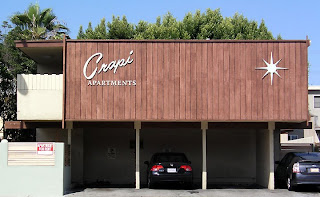

They represent to me the worst in tasteless design, bad architecture, poor urban planning and pedestrian-unfriendliness. Some of them, however, take 'bad' to a whole new level of kitschy high art.
Check them out on the FB page.... Dingbat "Fan" page.
Wiki on Dingbats:
"A dingbat is a type of formulaic apartment building that flourished in the Sun Belt region of the United States in the 1950s and 1960s, a vernacular variation of shoebox style "stucco boxes". Dingbats are boxy, two- or three-story apartment houses with overhangs sheltering street-front parking.[1] The elevation view of a dingbat is "half parking structure, half dumb box."[2]
Popular in Southern California, but also found in Arizona, Florida, Hawaii, Nevada and Vancouver, dingbats are known for their downmarket status and inexpensive rents. Some replaced more distinctive but less profitable building structures, such as single-family Victorian homes.[3] Since the 1980s they have been the subject of aesthetic interest as examples of Mid-Century modern design and kitsch, since many dingbats have themed names and specialized trim. Dingbats are also reviled as socially alienating visual blights; California historian Leonard Pitt said of them, "The dingbat typifies Los Angeles apartment building architecture at its worst."[1]"
Wiki Dingbat entry


They represent to me the worst in tasteless design, bad architecture, poor urban planning and pedestrian-unfriendliness. Some of them, however, take 'bad' to a whole new level of kitschy high art.
Check them out on the FB page.... Dingbat "Fan" page.
Wiki on Dingbats:
"A dingbat is a type of formulaic apartment building that flourished in the Sun Belt region of the United States in the 1950s and 1960s, a vernacular variation of shoebox style "stucco boxes". Dingbats are boxy, two- or three-story apartment houses with overhangs sheltering street-front parking.[1] The elevation view of a dingbat is "half parking structure, half dumb box."[2]
Popular in Southern California, but also found in Arizona, Florida, Hawaii, Nevada and Vancouver, dingbats are known for their downmarket status and inexpensive rents. Some replaced more distinctive but less profitable building structures, such as single-family Victorian homes.[3] Since the 1980s they have been the subject of aesthetic interest as examples of Mid-Century modern design and kitsch, since many dingbats have themed names and specialized trim. Dingbats are also reviled as socially alienating visual blights; California historian Leonard Pitt said of them, "The dingbat typifies Los Angeles apartment building architecture at its worst."[1]"
Wiki Dingbat entry
Tuesday, December 29, 2009
New Identity? Title? Themes?
I only recently started this blog, and a few others so I could share about the many different things I come across and find interesting. Much of what I stumble across are lesser-known ideas or real projects that could use more public support.
I started three blogs - but very quickly realized I needed to focus my efforts on only one, but that that ONE had to have content about ALL of my different interests. Which, over time, I'm sure you'll see, extend far beyond just the urban design and transportation issues I've been linking to on here so far.
There are some common themes though that I hope will emerge. Some of them I considered as names for the blog. "Genius Loci" was of them. It's a recurring theme in my thoughts that I'm sure will become apparent over time with my posts.
The "Genius Loci" translates to mean "Spirit of the Place." It's an ancient concept that goes back beyond the Romans from whom we get the term. The term featured prominently in my Architecture, Design and Landscape studies at my university. Each of my instructors (or "critics" as they're called in Architecture) was heavily influenced by the work and writings of Aldo Rossi, Robert Venturi and Lou Kahn. Each of these greats often spoke or wrote about finding something about the innate nature of the places or forms with which they worked. Those ideas really stuck with me, and 20+ years later - I still recall the words of and assignments by my instructors, and with each of my own new life experiences there is new light shed upon what I remember learning way back then.
What seemed like a quaint or cute concept back then is blossoming into something very real, very spiritual, awesome and more tangible with every day I combine my own experience, strength and hope with what the Genius Loci of each place has to reveal or inspire for me. The lessons of the Genius Loci can be easily lost in noise, ego or fear. It requires an inner peace, a quietude and patience to get to know a place and hear what the Spirit of the Place has to say.
I've lived in West Hollywood and Los Angeles for almost two years now. It's only very recently that I've been able to hear what this Genius Loci has to say. Why and how I came here, and why only now do I have the quietude, the presence and the stillness to listen will be the topics for future writings here. ...but for right now though, I'm content to feel and deeply understand why The Spirit of this place calls it the "The City of Angels."
I started three blogs - but very quickly realized I needed to focus my efforts on only one, but that that ONE had to have content about ALL of my different interests. Which, over time, I'm sure you'll see, extend far beyond just the urban design and transportation issues I've been linking to on here so far.
There are some common themes though that I hope will emerge. Some of them I considered as names for the blog. "Genius Loci" was of them. It's a recurring theme in my thoughts that I'm sure will become apparent over time with my posts.
The "Genius Loci" translates to mean "Spirit of the Place." It's an ancient concept that goes back beyond the Romans from whom we get the term. The term featured prominently in my Architecture, Design and Landscape studies at my university. Each of my instructors (or "critics" as they're called in Architecture) was heavily influenced by the work and writings of Aldo Rossi, Robert Venturi and Lou Kahn. Each of these greats often spoke or wrote about finding something about the innate nature of the places or forms with which they worked. Those ideas really stuck with me, and 20+ years later - I still recall the words of and assignments by my instructors, and with each of my own new life experiences there is new light shed upon what I remember learning way back then.
What seemed like a quaint or cute concept back then is blossoming into something very real, very spiritual, awesome and more tangible with every day I combine my own experience, strength and hope with what the Genius Loci of each place has to reveal or inspire for me. The lessons of the Genius Loci can be easily lost in noise, ego or fear. It requires an inner peace, a quietude and patience to get to know a place and hear what the Spirit of the Place has to say.
I've lived in West Hollywood and Los Angeles for almost two years now. It's only very recently that I've been able to hear what this Genius Loci has to say. Why and how I came here, and why only now do I have the quietude, the presence and the stillness to listen will be the topics for future writings here. ...but for right now though, I'm content to feel and deeply understand why The Spirit of this place calls it the "The City of Angels."
Subscribe to:
Posts (Atom)

 Posts
Posts


